
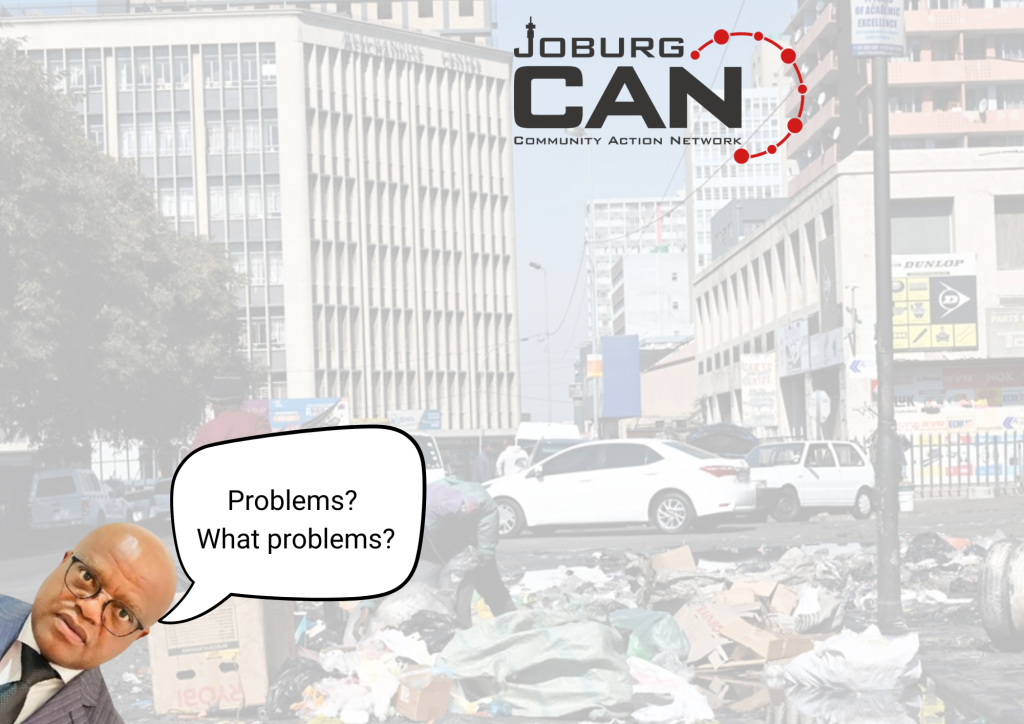
The City of Johannesburg cannot use cherry-picked statistics to create the impression of a city in recovery while residents continue to face a multitude of failures and deep uncertainty over whether the proposed budget is actually funded, says the Johannesburg Community Action Network (JoburgCAN).
Responding to Mayor Dada Morero’s State of the City Address, JoburgCAN said the speech presented selected improvements without enough detail on what those figures mean in practice for households, businesses and ratepayers.
“If the mayor’s optimistic picture of Johannesburg is accurate, then why are only around 60% of residents satisfied with service delivery?” said JoburgCAN managing director Julia Fish.
“Residents do not experience service delivery through percentages on a slide. They experience it when there is water in the tap, refuse is collected, traffic lights work, roads are repaired and billing queries are resolved.”
JoburgCAN said the mayor’s claim that 99.3% of residents receive water requires proper explanation.
“That figure is meaningless unless the city explains what kind of access residents have. How many households receive reliable piped water directly to their homes? How many are dependent on JoJo tanks, mobile storage units or water tankers? How many receive water on paper but experience repeated outages?” said Fish.
She said residents in suburbs such as Melville would not recognise claims of reliable water service after prolonged outages earlier this year, including a month-long battle for access in January.
“Access must not be confused with reliable service. A household that depends on tankers during repeated outages cannot be presented in the same way as a household with consistent piped water.”
JoburgCAN said the same concern applies to sanitation, housing and job creation claims.
The mayor’s reference to improvements in sanitation and housing access did not provide enough detail on the quality, reliability or location of those services.
Fish said the city must explain whether reported housing delivery refers to completed homes, serviced stands, planned units, projects under construction or projects that have merely broken ground.
“The mayor reportedly referred to 47 000 homes at Southern Farms, while also saying the project has broken ground. Both cannot mean the same thing. The city must clarify exactly what has been delivered, what is still planned and what residents can verify on the ground,” said Fish.
JoburgCAN said the mayor’s celebration of job creation also needs to be measured against the city’s weak financial position.
“If Johannesburg is attracting jobs and economic activity, then the city should be in a stronger position to attract investment, improve revenue collection and stabilise its finances. Instead, the city’s own budget documents show serious pressure,” said Fish.
In its recent submission on the draft 2026/27 Budget and Integrated Development Plan, JoburgCAN warned that the city is budgeting on optimistic revenue assumptions rather than achieved revenue.
The draft budget sets a 91% revenue collection target, despite the city’s own financial measures showing collections dropped to 86% in 2024/25.
The submission further said debt owed to the city for service charges and rates is expected to grow from R85.129 billion in 2025/26 to R114.466 billion in 2028/29, a 34.5% increase in three years, while the impaired portion of that debt is expected to grow from R70.877 billion to R100.215 billion over the same period – a massive 41% increase.
JoburgCAN said real financial interventions cannot be buried under selective statistics.
“Residents need honesty. They need a city that reports clearly on what is working, what has failed, what is funded, what is not funded and who will be held accountable,” said Fish.
For media queries contact Jonathan Erasmus on 073 227 6075