
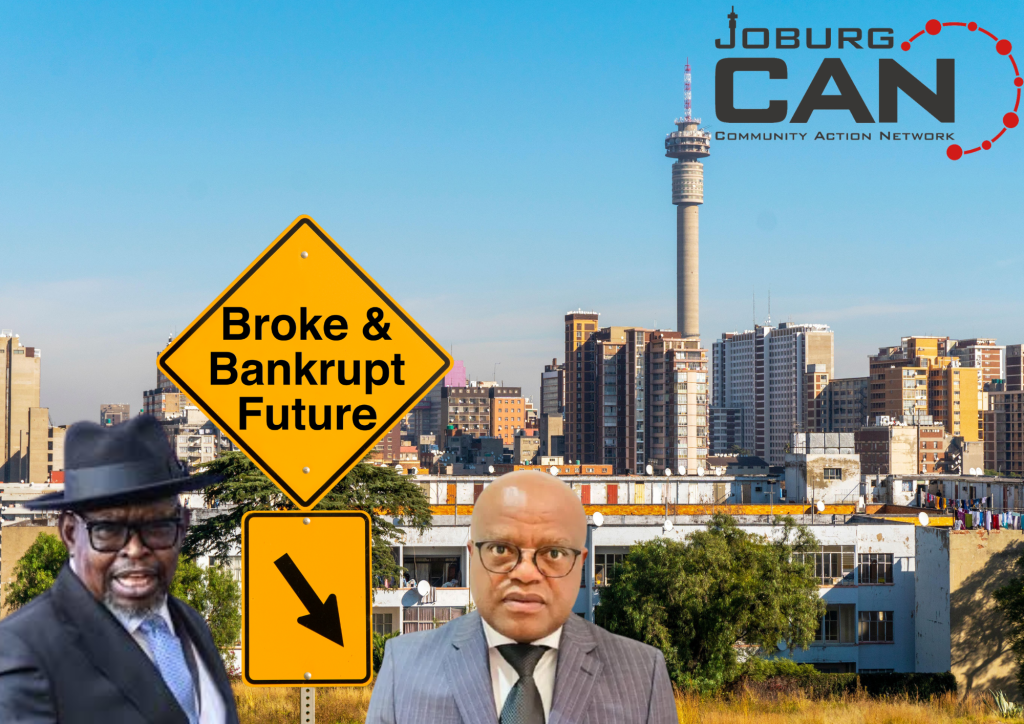
JoburgCAN says a damning letter from Finance Minister Enoch Godongwana to Johannesburg Mayor Dada Morero confirms what residents, businesses and civil society have been warning for months: the City of Johannesburg is passing budgets it cannot fund, cannot properly report on, and cannot responsibly control.
The minister’s letter, dated 23 April 2026, accuses the city of “serious violations” of the Municipal Finance Management Act and related regulations, and points to a deterioration in the city’s governance and financial health. It flags unrealistic revenue assumptions, weak collection performance, over-expenditure, Joburg Water revenue risks, Johannesburg Roads Agency (JRA) spending without cash backing, poor financial compliance, unpaid creditors and has explicitly called for the scrapping of the R10.3-billion wage deal signed off by the city earlier this year.
“This letter confirms what JoburgCAN has consistently said: Johannesburg is budgeting on hope, not cash,” said Julia Fish, Managing Director of JoburgCAN.
“The city’s budgets and adjustment budgets have repeatedly been built on revenue targets it is not able to meet. Instead of using realistic collection data, the city keeps presenting residents with numbers it says it is working towards achieving. That is not sound budgeting, and it has left Johannesburg with a major cash-flow crisis.”
Fish said one of the clearest external examples was that the JSE suspended the listing of the city’s debt securities on 27 March 2026 after the city failed to publish its audited annual financial statements for the year ended 30 June 2025 within the required period.
“This is exactly the consequence of weak financial controls,” Fish said.
Furthermore, the minister’s letter says the city’s creditors increased from R17 billion in 2022/23 to R25.2 billion in 2024/25, while cash and cash equivalents of R3.9 billion were insufficient to repay outstanding creditors.
The Minister’s letter calls this “a marker of severe financial distress”.
The MFMA requires municipalities to pay money owed within 30 days of receiving the relevant invoice or statement.
JoburgCAN said this is a direct threat to service delivery.
“When suppliers are not paid, services fail. We have seen repeated real examples, such as in the provision of water, where communities are left days, weeks and even months without a reliable source of water because of contractor non-payment,” Fish said.
JoburgCAN also noted the minister’s warning on the city’s agreement with the South African Municipal Workers’ Union, which the letter says committed Johannesburg to R10.3 billion in salary increases over two years despite the city’s financial distress. Godongwana directed the city to stop implementing what he called an “illegally signed agreement”.
“Lower-level workers who keep the city running deserve fair wages. Real austerity must start at the top: executive pay, senior management packages, excessive contractor spending and unaffordable wage decisions must all be reviewed,” said Fish.
JoburgCAN said it was concerned that National Treasury’s method to force the city to remedy the situation “with immediate effect” was to withhold the City’s equitable share allocation, if required.
“The equitable share is supposed to support indigent and vulnerable communities. If those funds are reduced or withheld, vulnerable residents are punished for failures they did not create. The consequences must fall on the political and administrative leadership that allowed this crisis to develop,” said Fish.
Fish urged Treasury to relook at its method of forcing the city to comply and to provide a cushion that will protect vulnerable communities.
JoburgCAN calls for:
- Immediate publication of a credible financial recovery plan.
- That a process be put in place that could see the city placed under formal administration.
- Performance management reviews and disciplinary action against executives and accounting officials responsible for funding and budget crisis.
- A review of the MMC for Finance’s role in the approval of the budgets that Treasury now says are not properly funded.
- A freeze on unaffordable salary increases while protecting fair wages for lower-paid workers.
- A full review of contractor and supplier spending.
- Protection of equitable share funding for vulnerable communities, with clear reporting on whether Joburg Water, City Power and other entities are receiving funds intended to support indigent residents.
For media queries contact Jonathan Erasmus on 068 923 6600 or email info@mycommunitysolutions.co.za