
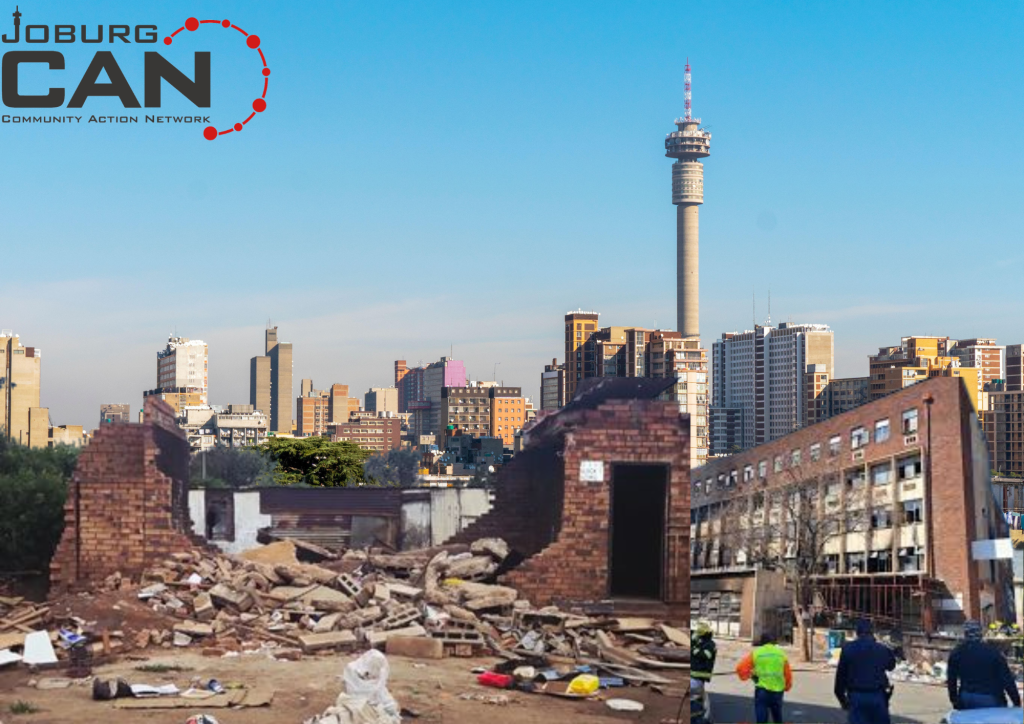
JoburgCAN has warned that Johannesburg’s growing pattern of building collapses, illegal land use, unchecked densification and infrastructure strain is not accidental, but the result of years of weak enforcement, poor oversight and a lack of accountability within the City’s Development Planning Department.
The civic organisation said illegal building activity, hijacked buildings, illegal utility connections and the overloading of infrastructure were no longer isolated governance failures, but signs of a city where rules increasingly exist only on paper.
“The decline of Johannesburg is not accidental. It is the direct result of weak enforcement, inconsistent oversight and a failure to act against unlawful and dangerous activity,” said Julia Fish, Managing Director of JoburgCAN.
Fish said the warning signs had been visible for years, yet the city continued to fail residents by not acting decisively where the law was being broken.
“The Ormonde building, for which no plans were submitted, collapsed and killed nine people earlier this month. In January, there was a house collapse in Soweto where the building was believed to have been structurally unsound. There was also the collapse of a wall in Doornfontein, possibly linked to an illegal gas connection, and of course the Marshalltown fire in 2023 in which 77 people died. And there are many more,” she said.
JoburgCAN said residents had a right to expect that the city would monitor whether building plans were approved, whether land use complied with zoning, whether additions and alterations were lawful, and whether buildings were being used safely and appropriately. Instead, the organisation said, oversight remained weak, enforcement inconsistent and consequences rare.
“One of the clearest examples is what happens when illegal building activity is identified. The city should act decisively, including by seeking stop work orders where necessary. Yet residents almost never see these matters followed through to a proper conclusion or court order obtained to restore the site and demolish illegal structure,” said Fish.
Fish said serious questions had to be asked about whether the city had either the budget or the political will to litigate these matters properly.
“When enforcement is not backed by legal muscle, the message is clear: break the rules, build first, and chances are nothing meaningful will happen and any later applications won’t take into account that there was illegal building beforehand,” she said.
JoburgCAN said communities regularly reported by-law infringements, but too often saw little or no response from the city.
“The city cannot pretend ignorance because communities do report these by-law infringements. We know this because when residents cannot get help, they turn to us at JoburgCAN. What’s missing is action.”
“Johannesburg is not declining because its problems are too complex to solve. It is declining because for too long there has been too little oversight, too little enforcement and too little accountability.”
For media enquiries contact Jonathan Erasmus on 073 227 6075