

The Johannesburg Crisis Alliance (JCA) has raised serious concerns about the financial and governance crisis facing the City of Johannesburg following its 55th Extraordinary Council Meeting on 30 September 2026.
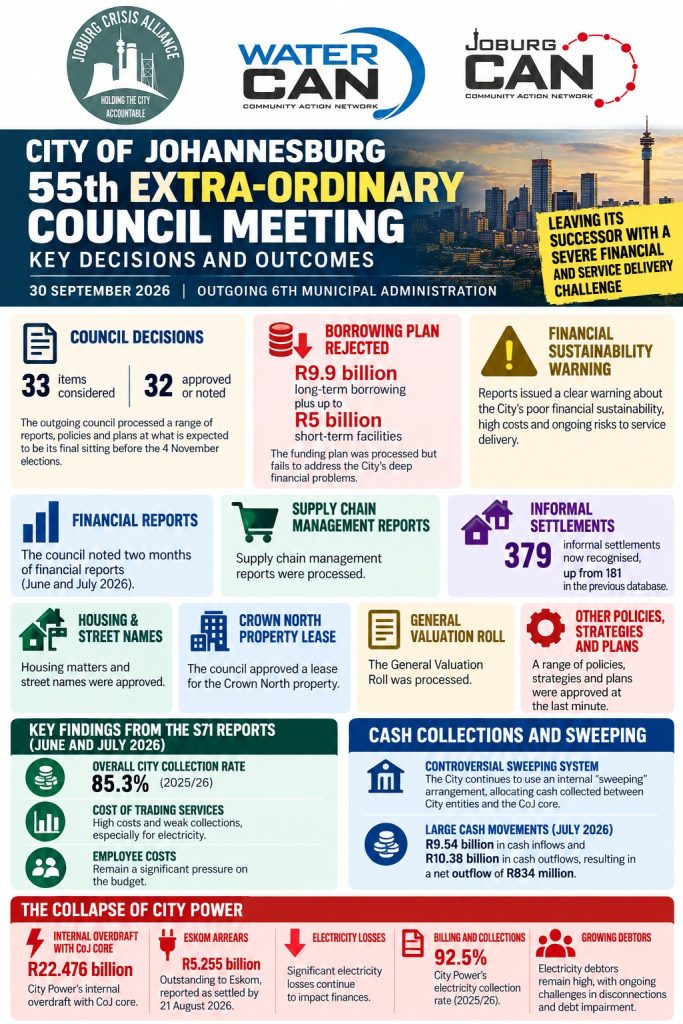
The meeting, expected to be the last before the municipal elections in November, saw 33 reports, policies and strategies rushed through council, with 32 approved or noted. Among the most concerning matters were a failed multibillion-rand borrowing proposal, continued financial mismanagement, inadequate oversight and a growing infrastructure and service-delivery crisis.
Financial reports tabled at the meeting revealed that the City had exceeded its operating budget by R4.8 billion during the 2025/26 financial year, failed to meet its revenue collection targets and spent only 72% of its adjusted capital budget.
The JCA, along with its partners JoburgCAN and WaterCAN, is particularly concerned that these developments have occurred while the City continues to struggle with declining liquidity, mounting consumer debt, deteriorating infrastructure and persistent service-delivery failures.
The Alliance believes the outgoing council is leaving its successor with a deeply compromised financial position that will require urgent intervention, greater transparency and stronger accountability.
Failed R9.9 billion borrowing proposal raises serious concerns
One of the most consequential items before council was a medium-term capital funding plan proposing approximately R9.9 billion in long-term borrowing over three years, beginning with R3.5 billion in 2026/27.
The proposal also included short-term borrowing facilities of up to R5 billion.
Despite receiving 117 votes in favour, appearing to be largely from the ANC and its allies, against 93 opposition votes, the long-term borrowing proposal failed to obtain the required 136 votes.
The JCA is concerned about the lack of transparency surrounding the proposed borrowing arrangements. City and council officials have subsequently declined to release the funding-plan documents tabled before council, preventing public scrutiny of the potential lenders, interest rates, repayment periods and projects intended to benefit from the financing.
The justification for the proposed R5 billion short-term borrowing facility also remains unclear, raising questions about whether the City is attempting to address a shortfall in its operational funding.
Of particular concern is the revenue collection assumption underpinning the proposal. While an ANC councillor indicated that collections had reached 90%, the City’s financial reports show that the overall collection rate for the 2025/26 financial year was just 85.3%, against a budgeted target of 88.5%.
The 90.2% collection rate reported for July 2026 represents a single month and cannot reasonably be treated as evidence of sustained revenue recovery.
The JCA believes council and residents are entitled to complete disclosure of the borrowing plan and the financial assumptions used to justify it.
Financial reports expose deepening municipal crisis
The June and July 2026 Section 71 financial reports, required under the Municipal Finance Management Act (MFMA), reveal the extent of the City’s deteriorating financial position.
The reports show that:
- Revenue collection overall for 2025/26 reached only 85.3%, below the budgeted 88.5%.
- Electricity collections reached 92.5%, while property rates stood at 88.9%, refuse at 74.7% and water at just 74.2% for 2025/26.
- Operating expenditure for 2025/26 exceeded the annual budget by 6%, equivalent to R4.8 billion.
- The City recorded a reported operating deficit of R1.2 billion at the end of 2025/26, against a budgeted surplus of R3.2 billion. The CoJ S71 report narrative refers to the deficit as R1.2 million, but Table C1 attached to the report indicates this is R1.2 billion.
- Only R6.1 billion of the adjusted R8.4 billion capital budget was spent by 30 June 2026, representing 72% of planned spending, subject to potential year-end accrual adjustments.
- Cash balances stood at R2.847 billion at the end of June and R2.012 billion at the end of July.
- Employee costs amounted to R2.026 billion in July alone.
These figures raise fundamental questions about the sustainability of the City’s finances and its ability to maintain infrastructure, deliver essential services and meet its financial obligations.
Of particular concern is the combination of revenue under-collection and operating overspending, while planned capital investment remains substantially below budget.
The JCA warns that Johannesburg cannot continue spending beyond its operational means while failing to invest adequately in the infrastructure on which residents and businesses depend.
Delayed financial reporting undermines council oversight
The JCA is equally concerned about the delayed tabling of the June and July Section 71 financial reports.
The MFMA requires monthly financial reports to be submitted by the City Manager to the mayor and provincial treasury within 10 working days of the end of each month.
Although the legislation does not expressly require these reports to be tabled before council, traditionally they are sent to the Section 79 Finance Committee for consideration and thentabled in council.
Both reports should have been available for scrutiny ahead of the council meeting on 26 and 27 August, but were tabled only on 30 September.
Concerns were also raised during the meeting that the reports had not first been considered by the Finance Committee.
These delays undermine the ability of councillors to identify financial risks, question expenditure and hold the executive accountable before financial problems become more severe.
The JCA believes timely financial reporting is a fundamental requirement for effective municipal governance and that repeated failures to provide these reports must have consequences.
Council’s own oversight committee warns of financial instability
The seriousness of Johannesburg’s financial position was reinforced by a background paper from council’s own Finance Committee, tabled at the 30 September meeting.
The paper warned:
“Persistent weaknesses in revenue collection, declining liquidity, increasing consumer debt, ageing infrastructure, repeated audit findings, governance shortcomings and service delivery challenges have collectively placed considerable strain on the City’s financial resilience.”
The committee also recorded that it had repeatedly raised concerns about the City’s financial management and requested remedial action from the executive.
It warned that Section 71 reports were frequently tabled several months late, preventing proactive oversight.
The report identified several major risks, including:
- Consumer debt amounting to R73.7 billion at the end of March 2026.
- Increasing costs for bulk electricity, bulk water, employees and borrowing.
- Withholding of National Treasury grant transfers.
- Non-payment of service providers, including circumstances resulting in an attachment order.
- Poor infrastructure maintenance and historically low capital spending.
- Underspending on national and provincial conditional grants.
- Repeated audit findings and procurement weaknesses.
- Strategies and plans without sufficiently clear implementation mechanisms, performance targets or accountability.
The JCA believes these findings are particularly significant because they come from council’s own oversight structures.
The incoming council cannot claim that it was unaware of the financial and governance risks confronting the municipality.
Last-minute policies raise questions about implementation and oversight
The outgoing council processed 14 policies, plans and strategies during what is expected to be its final meeting, raising concerns about why so many important governance decisions were left until the end of the council term.
Among these were the Informal Settlements Policy, Land Assembly Strategy, Skills Development Strategy, Gender-Based Violence and Femicide Strategy, revised Employment Equity Policy Framework, Disaster Management policies and the Economic Growth Strategy and Implementation Plan.
While many of these policy areas require urgent attention, approving strategies is not the same as implementing them.
The JCA is concerned that the City continues to adopt policies without demonstrating adequate financial provision, clear implementation timelines or measurable delivery targets.
The council’s own Finance Committee has already identified strategies without implementation frameworks and inadequate performance accountability as recurring governance problems.
These concerns must be addressed by the incoming administration.
Informal settlement figures reveal the scale of the service-delivery challenge
A significant report tabled before council revised Johannesburg’s official informal-settlement baseline from 181 to 379 verified settlements.
The estimated number of households living in these settlements has also increased from approximately 169 970 to about 365 000.
The updated information provides a more accurate basis for infrastructure planning, service provision and progressive settlement upgrading.
However, the report makes clear that official recognition does not guarantee immediate upgrading or capital investment.
The JCA believes the City must urgently translate this improved information into a funded and measurable programme for basic services, land acquisition where necessary, and progressive upgrading.
The scale of the revised figures also raises questions about the adequacy of previous planning assumptions and the City’s ability to respond to the needs of vulnerable communities.
Property valuations, procurement and municipal assets require scrutiny
The JCA also notes several other decisions and reports that raise concerns about the management of public resources.
Council extended the validity of the General Valuation Roll 2023 to 30 June 2028, citing staff shortages and procurement difficulties. The City reportedly has approximately 13 000 properties per valuer.
Property valuations form the basis of municipal rates, making delays in updating the valuation roll a matter of concern for the City’s revenue management.
Council also agreed to proceed with consideration of an amended lease involving municipal land in Crown North, where questions were raised about the existing use of the property, returns to the City and inadequate oversight.
Procurement reports revealed that the City’s core departments had made approximately R9.1 billion in direct purchases during the 2025/26 financial year.
The reports also noted that of R101.8m in stock, R26.2 million was marked for deletion and referred to Group Forensic Investigation Services, reducing the provisional stock value to R75.6m.Further concerns emerged over municipal contracts and service-provider panels that were approaching expiry or had already expired by the time the relevant reports reached council.
These issues point to the need for significantly stronger contract management, procurement oversight and protection of municipal assets.
JCA calls for urgent action and full financial transparency
The Johannesburg Crisis Alliance believes the findings and decisions of the 30 September council meeting reinforce the urgent need for financial recovery, transparent decision-making and meaningful accountability.
The Alliance calls for:
- Full disclosure of the failed borrowing proposal, including the funding-plan documents, proposed lenders, interest rates, repayment arrangements, intended projects and justification for the R5 billion short-term facility.
- Implementation of the City’s Financial Turnaround Framework, adopted by council in June 2026, with public tracking of indicators and deadlines.
- Timely publication and scrutiny of Section 71 financial reports, with reports made available to the Finance Committee and the public sufficiently promptly to allow effective oversight.
- An urgent review of operating expenditure and capital underspending, including measures to address budget overruns, protect infrastructure investment and improve grant utilisation.
- Implementation of the Finance Committee’s oversight recommendations, with clearly assigned responsibilities, performance indicators and deadlines for remedial action.
- Full transparency over procurement, expiring contracts, asset management and municipal property transactions, including disclosure of financial implications and measures to protect public resources.
- Funded implementation plans for council-approved policies and strategies, ensuring that commitments translate into measurable improvements in service delivery.
- A transparent transition to the incoming council, including comprehensive disclosure of the City’s financial position, outstanding liabilities, borrowing commitments, infrastructure backlogs and unresolved governance risks.
The JCA maintains that Johannesburg’s financial crisis cannot be resolved through further borrowing, policy announcements or administrative restructuring alone.
It requires disciplined expenditure management, improved revenue collection, properly funded infrastructure maintenance, effective oversight and political leadership prepared to confront longstanding governance failures.
The outgoing council’s final meeting has exposed the seriousness of the challenges facing the next administration.
The incoming council must make financial accountability, transparent governance and measurable service-delivery improvements its immediate priorities.
For media inquiries contact Jonathan Erasmus on 073 227 6075